Best Climbing Gear United States: An Editorial Pillar Guide to Vertical Systems
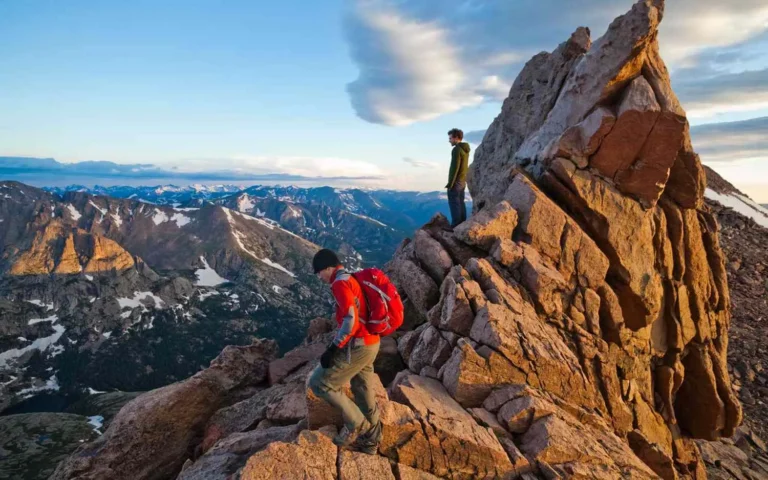
The American climbing landscape is a geological paradox, offering everything from the smooth, glacier-polished granite of the Sierra Nevada to the sharp, fossilized limestone of the Mountain West and the gritty, friction-dependent sandstone of the Southeast. For the practitioner, this diversity necessitates a highly specialized approach to equipment. Climbing gear in the United States is not a monolithic category; it is a fragmented ecosystem of mechanical devices, textile engineering, and metallurgical choices designed to interface with specific rock types and environmental stressors. The transition from a gym environment to the vast verticality of the American wilderness represents a massive leap in technical complexity, where the equipment must serve as a redundant life-support system in high-consequence environments.
The search for the most effective tools is often obscured by marketing hyperbole and the rapid cycle of product releases. However, a senior editorial perspective views gear through the lens of structural integrity, ergonomic efficiency, and historical reliability. This ethos of “clean climbing” has driven American manufacturers to lead the world in the development of spring-loaded camming devices and specialized nut geometries that accommodate the idiosyncratic cracks of the American continent.
Understanding the current state of vertical equipment requires an analysis of the tension between weight and durability. As the “fast and light” philosophy gains traction in the alpine corridors of the Cascades and the Tetons, the margins for error have narrowed. Thin-diameter ropes and ultra-lightweight carabiners offer significant advantages in energy conservation, yet they demand a more rigorous maintenance protocol and a deeper understanding of wear patterns. This article provides a definitive exploration of these dynamics, offering a comprehensive framework for evaluating the tools that facilitate the American vertical experience.
Understanding “Best Climbing Gear United States”
To identify the best climbing gear united states, one must first decouple the concept of “best” from “most expensive” or “newest.” In the context of American climbing, “best” is a function of the rock’s geology and the climber’s systemic proficiency. A gear set optimized for the quartzite of the Gunks in New York will fail fundamentally when applied to the limestone pockets of Tensleep, Wyoming. The American market is unique because it demands equipment that can handle extreme thermal expansion, high UV exposure in alpine zones, and the abrasive nature of varied mineral compositions.
A common oversimplification in gear acquisition is the “all-arounder” fallacy. Many beginners seek a single rope or a single set of cams that can perform across all disciplines. While versatility exists, the high-tier practitioner understands that specialization is the true hallmark of quality. Technical mastery involves knowing when to prioritize the “bite” of a soft-rubber shoe for friction slab versus the “edging” stiffness required for micro-features. The risk here is not just inefficiency, but the acceleration of gear fatigue when tools are used outside their intended environmental parameters.
Furthermore, the United States regulatory and certification environment (primarily UIAA and CE standards) ensures a baseline of safety, but it does not account for the nuances of “feel” and “feedback.” The best gear provides the climber with high-fidelity sensory information—the way a cam “sets” into a granite crack or the way a rope “stretches” during a dynamic fall. This feedback loop is essential for making real-time safety judgments in the backcountry where rescue is not guaranteed.
Deep Contextual Background
The lineage of American climbing gear is inextricably linked to the “Piton Era” of the mid-20th century. Pioneers in Yosemite Valley relied on iron and chrome-molybdenum spikes hammered into cracks. However, as the cumulative damage to the rock became apparent, a systemic shift occurred in the early 1970s. The “Clean Climbing” revolution, championed by figures like Yvon Chouinard and Doug Robinson, introduced the concept of removable protection. This was the birth of the modern American gear aesthetic: the nut and the hex.
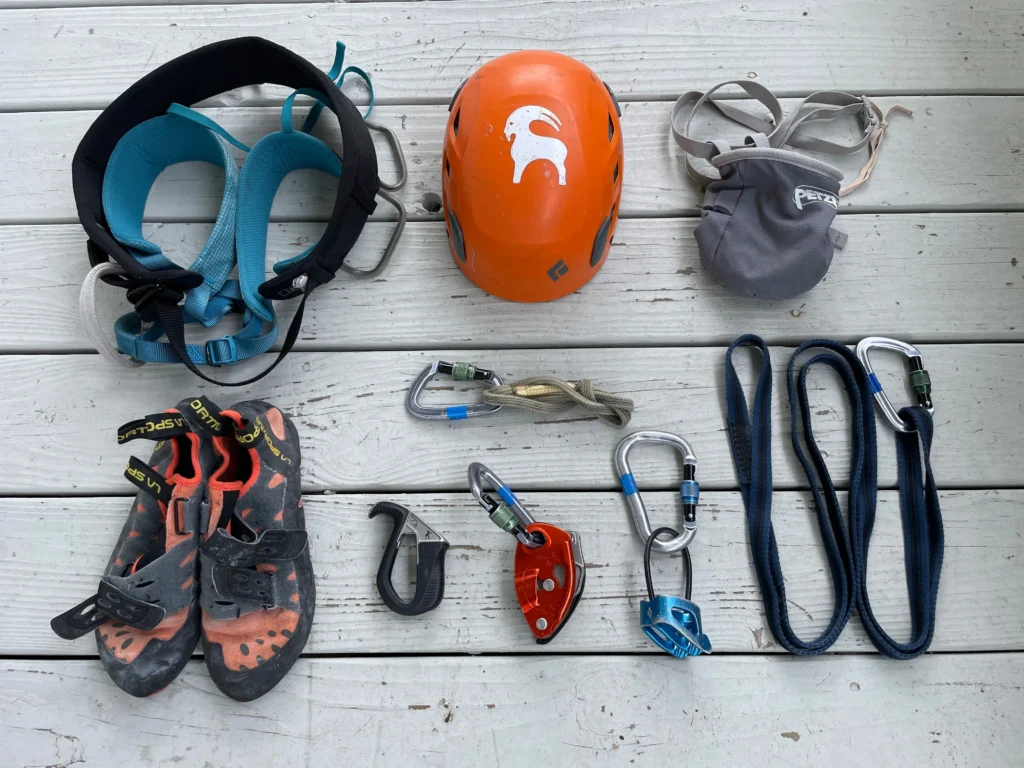
In 1978, the introduction of the Spring-Loaded Camming Device (SLCD), or “Friend,” fundamentally altered what was possible on the wall. This American-born innovation allowed for protection in parallel-sided cracks that were previously unprotectable. Since then, the evolution has moved toward refinement rather than revolution. We have seen the transition from heavy steel to lightweight aluminum alloys, the introduction of “dyneema” and “spectra” high-modulus polyethylenes for slings, and the development of assisted-braking belay devices that mitigate human error during long belay sessions.
The systemic evolution also includes the “Gym-to-Crag” pipeline. As climbing transitioned from a fringe outdoor activity to an Olympic sport, the demand for gear shifted toward ergonomic comfort and aesthetic appeal. This has created a bifurcated market: high-volume, user-friendly gear for the recreational climber, and specialized, high-performance assets for the professional and expeditionary elite.
Conceptual Frameworks and Mental Models
The “Systemic Redundancy” Model
In climbing, no single component should be the sole point of failure. This framework dictates how gear is selected and used in tandem. For instance, the use of two opposed carabiners on a critical anchor or the “clove hitch” as a secondary tether. When evaluating the best gear, one must ask: “How does this component contribute to the redundancy of the overall system?”
The “Strength-to-Weight-to-Durability” Triangle
Every piece of gear exists in a state of compromise between these three points.
-
Strength: The peak force the gear can withstand (measured in kilonewtons).
-
Weight: The energy cost of transporting the gear.
-
Durability: The resistance to abrasion and cycle fatigue.
For a “Big Wall” climber, durability is paramount. For an “Alpine” climber, weight takes precedence. The mental model here is “Optimization for Mission Profile.”
The “Margin of Safety” Framework
This involves calculating the difference between the expected force of a fall and the breaking strength of the weakest link in the chain. In the United States, where “trad” climbing involves placing your own protection, the margin of safety is not just a hardware spec; it is a judgment call on the quality of the rock and the placement of the gear.
Key Categories and Variations
Core Equipment Comparison for the US Market
| Category | Primary Material | Ideal Environment | Trade-off |
| Active Protection (Cams) | Aluminum Alloy / Stainless Steel | Parallel Cracks (Granite/Sandstone) | Weight and Cost |
| Passive Protection (Nuts) | 6061 Aluminum | Irregular Cracks / Constrictions | Harder to Place/Remove |
| Dynamic Ropes | Polyamide (Nylon) | All Climbing Disciplines | Susceptible to UV and Chemicals |
| Carabiners | Hot-Forged Aluminum | Safety Interfacing | Wear over time (Grooving) |
| Harnesses | Polyester / High-Density Foam | Multi-Pitch / Sport | Bulky vs. Minimalist comfort |
Active Protection: The Camming Ecosystem
The gold standard for best climbing gear united states often starts with active protection. Double-axle designs, which allow for a larger expansion range, are the preferred choice for the varied crack sizes found in Indian Creek or Yosemite. The technical nuance lies in the “camming angle”—typically around 13.7 degrees—which balances the outward force against the risk of the device “walking” out of the crack.
Textiles: The Science of Impact Absorption
Dynamic ropes are the most critical textile in the system. Unlike static ropes used in hauling, dynamic ropes are designed to stretch up to 30-40% during a fall, absorbing the kinetic energy that would otherwise be transferred to the climber and the protection. The current trend in the US is toward “dry-treated” ropes, which prevent water absorption—a necessity for the ice and mixed climbing found in the Northeast and the Rockies.
Detailed Real-World Scenarios
Scenario 1: The Granite Big Wall (El Capitan)
-
Constraint: 3,000 feet of vertical granite; multi-day ascent.
-
Gear Selection: Offset cams (for flared pin scars), heavy-duty haul bags, and double-braid ropes.
-
Failure Mode: “Sheath Slippage.” Repeated hauling can cause the outer sheath of a rope to bunch, making it incompatible with mechanical ascenders.
-
Second-Order Effect: The weight of a “triple rack” of cams leads to physical exhaustion, increasing the likelihood of a navigational error on the route.
Scenario 2: High-Volume Sport Climbing (Smith Rock)
-
Constraint: Sharp volcanic tuff; high-frequency falls.
-
Gear Selection: Steel-insert carabiners for fixed draws (to prevent rope grooving) and high-tension shoes.
-
Result: Reduced gear replacement frequency, but increased weight on the harness.
Planning, Cost, and Resource Dynamics
The financial barrier to entry for high-end climbing is significant, particularly for those transitioning into traditional or alpine disciplines.
Investment Tiers for American Climbing (USD)
| Component | Standard Entry | Professional / Expedition Grade |
| Complete Cam Set (0.3 – 4) | $500 – $700 | $1,200 – $2,000 (Ultralight versions) |
| Dynamic Rope (60m-70m) | $180 – $250 | $350 – $450 (Bi-pattern / Dry-treated) |
| Harness & Shoes | $200 – $350 | $500 – $700 (Specialized uppers/carbon shanks) |
| Passive Protection Set | $100 – $150 | $250 – $400 (Micro-offsets / Brassies) |
| Quickdraws (12 pack) | $150 – $250 | $400 – $600 (Ergonomic / Weight-optimized) |
Resource Variability
The “Depreciation of Safety” is a unique cost factor. Unlike a hiking boot that can be worn until it falls apart, climbing gear must be retired based on time and usage cycles, even if it “looks fine.” This creates a recurring operational cost that must be factored into the climber’s annual budget.
Tools, Strategies, and Support Systems
-
Rack Organization Strategy: Using color-coded carabiners that match the cam lobe color to reduce “cognitive load” during stressful placements.
-
Rope Management (Flaking): The use of rope bags to prevent “twisting” and to protect the nylon from ground-level abrasives like sand and dirt.
-
Mechanical Advantage Systems: Knowledge of 3:1 or 5:1 hauling systems for self-rescue or moving heavy loads.
-
Taping and Skin Care: Using high-zinc oxide athletic tape to protect hands in abrasive cracks, preserving the “biological gear” (skin).
-
Digital Beta and Topos: Utilizing GPS-integrated mapping apps for approach and descent navigation in complex terrain like the North Cascades.
-
Belay Glasses: Using prism glasses to prevent “belayer’s neck,” a cumulative stress injury common in high-volume cragging.
Risk Landscape and Failure Modes
The “Risk Taxonomy” of climbing gear is dominated by human-hardware interface errors and environmental degradation.
Compounding Risks
A “Micro-Fall” on a sharp edge can create a burr on a carabiner. If that carabiner is subsequently used with a rope, the burr acts as a blade, compromising the rope’s sheath. This is a “Compounding Failure”—a minor, often unnoticed mechanical issue that leads to a catastrophic system failure later.
Environmental Degradation
In the high-UV environments of Colorado or California, the “UVA/UVB” breakdown of nylon slings is an insidious risk. A sling that appears structurally sound may have lost 50% of its tensile strength due to sun exposure. This requires a strict “date-based” retirement policy for all “soft” gear.
Governance, Maintenance, and Long-Term Adaptation
The Gear Retirement Checklist
-
Visual Inspection: Check for cracks in metal (especially at gates and rivets) and “fuzziness” or “flat spots” in ropes.
-
Tactile Inspection: Feel for “core shots” in the rope—places where the inner core has been damaged despite an intact sheath.
-
The “Five-Year Rule”: Regardless of appearance, many manufacturers recommend retiring soft goods (slings, harnesses) after five years of moderate use.
-
The “Drop Rule”: While modern aluminum is resilient, any gear that takes a significant fall onto a hard surface should be inspected for micro-fractures, though this is a debated topic in the metallurgical community.
Measurement, Tracking, and Evaluation
-
Leading Indicators: Number of falls taken on a rope, hours of UV exposure, and the “stiffness” of cam springs.
-
Lagging Indicators: Visible wear on carabiner baskets, sheath fraying, and shoe sole thinning.
-
Documentation: Serious climbers often maintain a “Rope Log,” tracking the date of purchase and the number of significant “leader falls” the rope has arrested.
Common Misconceptions and Oversimplifications
-
“Cams are foolproof.” Cams are active protection; if placed in poor rock or at a bad angle, they can “rip” or “walk,” failing entirely.
-
“Assisted braking devices mean you don’t need to hold the rope.” This is a dangerous myth. The “brake hand” must never leave the rope, regardless of the device’s mechanical assistance.
-
“Stiffer shoes are better for beginners.” While they provide support, they can prevent the development of proper “foot feel” and sensitivity.
-
“Used gear is a bargain.” Unless the history of the gear is known with 100% certainty, buying used life-support equipment is a high-risk gamble.
-
“Waterproof gear is better.” For climbing, “breathability” is often more important than “waterproofness” to prevent internal condensation that leads to chilling during stationary belays.
Ethical and Practical Considerations
The “Ethics of Permanence” is a major debate in the United States. This has led to a push against “bolting” (drilling permanent anchors) in wilderness areas. Practitioners must weigh their desire for safety against the cultural and ecological value of “unspoiled” rock. Additionally, the manufacturing of climbing gear involves intensive metallurgical processes; many top brands are now moving toward recycled aluminum and PFC-free textile treatments to mitigate their environmental footprint.
Conclusion
The selection and maintenance of vertical equipment in the United States is an exercise in “Intellectual Honesty.” It requires a climber to look beyond the brand and into the physics of the system. The vertical landscape is an unforgiving environment where the “best” gear is ultimately the gear that the climber understands most intimately.
As we move toward even more advanced materials—such as carbon-fiber reinforced components and smart-textiles that can signal their own fatigue—the core requirement remains the same: a deep, systemic understanding of how human weight and kinetic energy interact with the ancient geology of the continent. The mastery of vertical tools is not an end in itself, but a means to safely engage with the profound silence and immense scale of the American wilderness.