Top Hiking Experiences in America: A Comprehensive Editorial Pillar Guide
Top hiking experiences in America. The American landscape is a geological mosaic that defies singular definition, offering a topographical diversity that ranges from the glaciated peaks of the Cascades to the limestone karst of the Ozarks and the ancient, weathered ridges of the Blue Ridge Mountains. Hiking in the United States is more than a recreational pursuit; it is a profound engagement with a continental-scale wilderness system preserved through a complex web of federal, state, and local management. The scale of this network—encompassing over 190,000 miles of trails—demands a sophisticated approach to selection and preparation that goes beyond simply identifying “popular” destinations.
A definitive exploration of the premier trekking opportunities requires an analytical lens that considers the intersection of seasonal timing, ecological fragility, and physical demand. The sheer variety of biomes available to a hiker in North America means that a “top” experience is rarely a fixed point in space; it is a temporal window where weather, light, and trail conditions align. For the serious practitioner, the goal is to move past the commodified “bucket list” approach and toward a deep understanding of the environmental systems that make certain routes inherently superior in their category.
The institutional framework supporting these trails, primarily governed by the National Park Service (NPS), the U.S. Forest Service (USFS), and the Bureau of Land Management (BLM), creates a unique regulatory environment. This governance ensures that the most pristine areas remain intact but also imposes a logistical burden on the user—permits, seasonal closures, and strictly enforced ethical standards are as much a part of the experience as the terrain itself. To master the art of the American hike is to master the logistics of the American bureaucracy and the physics of its most unforgiving climates.
Understanding “Top Hiking Experiences in America”
To categorize top hiking experiences in America, one must first deconstruct the term “top.” In a high-authority editorial context, this does not refer to the most “Instagrammable” locations or the trails with the highest foot traffic. Rather, it refers to “High Fidelity” experiences—routes that provide the most distilled, unfiltered encounter with a specific geological or biological phenomenon. A top experience in the Desert Southwest forces an understanding of hydraulic erosion; in the Pacific Northwest, it demonstrates the overwhelming power of old-growth forest succession.
The risk of oversimplification in this field is high. Many guides conflate “difficulty” with “quality,” assuming that a 14,000-foot peak is inherently more valuable than a low-elevation swamp trail. This is a cognitive bias. The true quality of a hike is found in its “Topical Integrity”—how well the trail communicates the story of its landscape. A top-tier experience is also defined by its scarcity and the complexity of its access. If a location is easily reachable by any casual tourist, the ecological and psychological “signal” of the wilderness is often drowned out by human noise.
Furthermore, the American perspective on hiking is deeply tied to the concept of “The Frontier.” Unlike European trekking, which often moves between mountain huts and established villages, the American ideal emphasizes self-sufficiency and the “Primitive and Unconfined” experience mandated by the Wilderness Act of 1964. Therefore, the most prestigious experiences are often those that require a total separation from modern infrastructure, forcing a reliance on internal judgment and technical gear.
Historical and Systemic Evolution
The trails we walk today are rarely new constructions; they are the geological and cultural remnants of centuries of movement. The Appalachian Trail (AT), for example, was conceived in 1921 not just as a path, but as a social project—a “realm of the spirit” to counter the industrialization of the East Coast. Conversely, the Pacific Crest Trail (PCT) evolved through a more rugged, individualistic framework, following the spine of the mountains through vast tracts of federal land that were never successfully settled.
Systemically, the evolution of American hiking is a story of land management transitions. In the early 20th century, the focus was on “Resource Extraction” (logging and mining), with trails serving as access points for surveyors. The shift toward “Resource Appreciation” (recreation) only became the dominant paradigm post-WWII, as the American middle class gained the leisure time and mobility to seek out the wild. This transition created the modern trail maintenance crisis: paths designed for five surveyors a year are now being used by 5,000 hikers a season, leading to significant soil compaction and erosion.
Modern trail systems also reflect a “Bureaucratic Maturation.” We have moved from the era of “open access” to an era of “restricted quotas.” The most iconic routes, such as the John Muir Trail or the Enchantments in Washington, now operate on lottery systems. This systemic shift defines the modern experience: the hike begins six months before the first step is taken, at the computer terminal during the permit application window.
Conceptual Frameworks for Trail Selection
Selecting an elite hiking experience requires a multi-dimensional mental model that accounts for more than just mileage.
The “Temporal Alignment” Model
This framework posits that every trail has a “Peak State” and a “Degraded State.” A hike in the Zion Narrows is a top experience in late June (low water, warm air) but a high-risk liability in April (spring runoff, hypothermia). The model requires the hiker to map the ecological triggers of a region—wildflower blooms, monsoon cycles, and mosquito hatches—to the calendar.
The “Difficulty-to-Reward Ratio” (DRR)
The DRR is a subjective but essential metric. Some trails offer high rewards for low effort (e.g., certain coastal overlooks in Acadia), while others demand extreme physical tolls for abstract rewards (e.g., long-distance green tunnels in the AT). The sophisticated hiker seeks “Asymmetric Rewards”—trails where technical navigation or specific timing unlocks views and solitude that disproportionately outweigh the physical cost.
The “Human-Wilderness Gradient”
This model assesses a trail based on its level of isolation.
-
Front-country: Paved, high facility, high traffic.
-
Back-country: Maintained trails, designated campsites.
-
Cross-country: No trails, reliance on topographic maps and compass work.
The most esteemed experiences in America are typically found in the transition between Level 2 and Level 3, where the infrastructure fades, but the landscape remains navigable.
Key Categories: From Alpine Ascents to Desert Canyons
The American trail system can be categorized by “Bioregional Signature.” Each category offers a different failure mode and a different set of technical requirements.
Comparison of Primary Hiking Bioregions
| Bioregion | Example Trail | Key Technical Demand | Primary Environmental Risk |
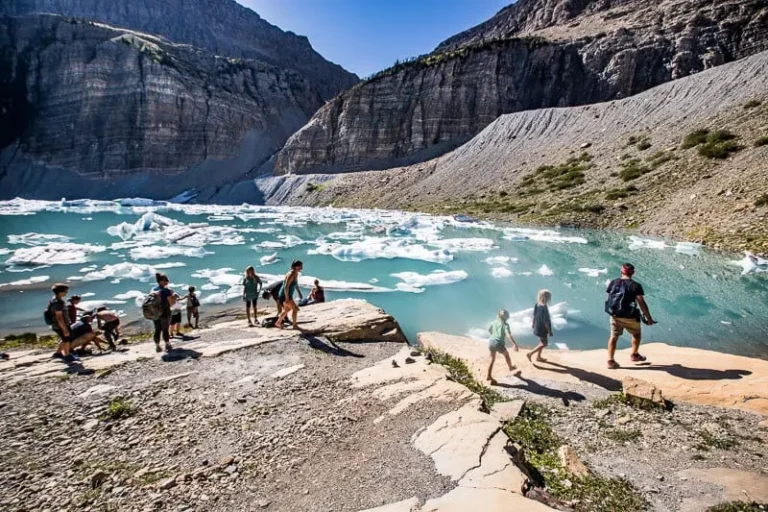
| High Alpine | Grinnell Glacier (Glacier NP) | Vertical Gain & Ozone | Lightning & Exposure |
| Arid Canyon | The Wave (Arizona/Utah) | Navigation (Trackless) | Flash Floods & Dehydration |
| Coastal Temperate | Kalalau Trail (Hawaii) | Traction & Mud Management | Cliff Erosion |
| Boreal Forest | High Peaks (Adirondacks) | Moisture Management | Hypothermia (Wet-Cold) |
| Volcanic/Crater | Skyline Trail (Mt. Rainier) | Snow Travel Skills | Crevasses & Glissading |
Arid Canyons: The Architecture of Water
Hiking in the American Southwest is an exercise in negative space. Here, the “top” experiences are often found within the earth rather than on top of it. Slots like Antelope Canyon or the Paria Canyon-Vermilion Cliffs require a “Hydraulic Intelligence.” Hikers must understand the drainage basins miles upstream, as a storm in a distant mountain range can send a wall of water through a dry wash in minutes.
The High Alpine: The Thin Air Threshold
In the Rockies and the Sierra Nevada, the experience is dictated by the “Treeline.” Once a hiker crosses the 11,000-foot mark, the ecology shifts to an arctic tundra. These routes are characterized by “Ozone Clarity”—a visual sharpness caused by thin air—but they require a “Rapid Descent Plan.” In America, the 2:00 PM lightning rule is a standard ssafety guideline if you aren’t off the peak by mid-afternoon, you are at the mercy of the atmosphere.
Detailed Real-World Scenarios
Scenario 1: The Cascadian Shoulder Season
-
Location: North Cascades, Washington.
-
Condition: Early October. The “Larch Madness” (turning of deciduous conifers) is peaking, but a low-pressure system is moving in.
-
Decision Point: Proceeding to a high-elevation pass.
-
Failure Mode: “The Rain-Snow Line.” A hiker equipped for cold rain encounters heavy, wet “mashed potato” snow. Gear saturation leads to stage-one hypothermia before a tent can be pitched. This scenario highlights the risk of “Aesthetic Tunnel Vision,” where the beauty of the larches blinds the hiker to the shifting pressure on the barometer.
Scenario 2: The Desert Slot “No-Flow” Day
-
Location: Buckskin Gulch, Utah.
-
Constraint: 13 miles of deep canyon with no exits.
-
Outcome: The hiker identifies “debris wedging” 20 feet above the canyon floor.
-
Second-Order Effect: Even without rain, the “Sand Heat” in the canyon floor can reach 110°F, while the lack of wind prevents evaporative cooling.
Planning, Cost, and Resource Dynamics
The economics of a premier hiking trip in America have shifted from “low-cost leisure” to “significant investment.” This is particularly true when accounting for the gear-to-environment match.
Estimated Resource Allocation (High-End Trek)
| Item | Est. Cost (USD) | Logic for Investment |
| Lightweight Shelter | $400 – $850 | Weight-to-Strength ratio for high winds. |
| Permit/Lottery Fees | $10 – $100 | Access to restricted “Signal” areas. |
| Satellite Communicator | $300 – $500 | Necessary for the “Zero-Cell-Service” zones. |
| Technical Footwear | $150 – $300 | Biome-specific (Gore-Tex vs. Breathable Mesh). |
| Logistics (Shuttles/Gas) | $200 – $600 | Remote trailhead access and “Point-to-Point” routes. |
The “Opportunity Cost” of a top hiking experience is also measured in time. Many of the best American trails are “Seasonal Goldilocks” zones, where the window of accessibility is only 6–8 weeks long. Missing that window means a 10-month wait for the next cycle.
Tools, Strategies, and Support Systems
To elevate a hike from a walk to an “experience,” certain support systems must be deployed to manage environmental friction.
-
The “Three-Layer” Moisture Strategy: Moving away from heavy waterproofs to a system of wind-shells, active insulation, and breathable baselayers to prevent “sweating out” from within.
-
Topographic Pre-Visualization: Using LIDAR-based mapping software to “fly through” a route before arrival, identifying potential campsites that aren’t on the official maps.
-
Caloric Density Planning: Moving past “snack food” to a 125-calorie-per-ounce ratio for multi-day efforts, ensuring energy levels don’t crash during the “final mile” ascent.
-
Biological Mitigation: Strategies for Tick-borne illnesses (East Coast) or Giardia (West Coast), including Permethrin-treated clothing and 0.1-micron water filtration.
-
Offline Data Redundancy: Carrying paper maps even when using GPS; electronics fail in the cold, and “lithium death” is a leading cause of navigational error.
-
The “LNT” Digital Protocol: Scrubbing metadata and “geotags” from photos before sharing to prevent “Over-Tourism” of sensitive ecological zones.
Risk Landscape and Failure Modes
The “Risk Taxonomy” of American hiking is divided between the “Acute” (sudden onset) and the “Insidious” (gradual degradation).
Compounding Risks
A common failure in the High Sierra is the “Cold-Hunger-Navigation” loop.
-
The hiker gets cold.
-
The body burns calories to stay warm, leading to a caloric deficit.
-
The brain, deprived of glucose, begins to make poor navigational choices.
-
The hiker gets lost, stays out longer, and gets colder.
In the context of top hiking experiences in America, the “luxury” of the scenery is often a distraction from the reality that the hiker is a biological engine running on a finite fuel supply.
Governance, Maintenance, and Long-Term Adaptation
American trails are “living assets” that require constant governance. The “National Trail System Act” provides the legal framework, but the physical work is often done by volunteer organizations like the PCTA or the ATC.
The Maintenance Crisis
Climate change has introduced “Dynamic Risk” to the governance of trails. Increased forest fire frequency in the West has led to “Ghost Trails”—once-popular routes that are now impassable due to “Blowdown” (fallen trees) and soil sterilization. Long-term adaptation for the hiker means monitoring “Fire Closure Maps” as closely as weather reports.
Measurement, Tracking, and Evaluation
How do you measure a “top” experience?
-
Quantitative: Elevation gain per mile, “Time-on-Trail” vs. “Time-in-Transit,” and “Recovery Time.”
-
Qualitative: The “Solitude Index”—the number of other groups encountered per hour.
-
Documentation: A successful hiker maintains a “Field Journal,” not just for memories, but to track water source reliability and campsite quality for future cycles.
Common Misconceptions and Oversimplifications
-
“National Parks are the only place for top hikes.” Many of the best experiences are in “Wilderness Areas” within National Forests, where regulations are slightly looser but crowds are non-existent.
-
“High-end gear makes the hiker.” Gear only mitigates discomfort; it does not replace “Trail Sense” or the ability to read a clouded sky.
-
“Summer is hiking season.” In the South, Summer is “Survival Season.” The top experiences there happen in the deep winter or early spring.
-
“The trail will always be there.” Due to erosion and budgetary cuts, many trails are being “decommissioned” or left to the forest. The experience is often a “once-in-a-generation” window.
Ethical and Practical Considerations
The “Colonial History” of American trails is an ethical consideration that is gaining traction. Many “Discovery” routes follow indigenous trade paths. A sophisticated hiker acknowledges the “Indigenous Presence” of the land, moving beyond the “Terra Nullius” (Empty Land) myth that dominated early 20th-century conservation.
Conclusion
The pursuit of the top hiking experiences in America is ultimately a pursuit of “Environmental Literacy.” It is the ability to walk into a landscape and understand the forces of geology, the patterns of weather, and the fragility of the local flora. The American wilderness provides a vast, silent laboratory for this study. Whether one is standing on the edge of the Continental Divide or navigating the moss-drenched forests of the Olympic Peninsula, the experience is a reminder of the scale of the natural world and the small, precise place we occupy within it. To hike well is to walk with a sense of “intellectual honesty,” accepting the discomfort and the beauty as equal parts of a singular, profound reality.